Most destinations offer sights. Bhutan offers something harder to package and impossible to forget – a fundamental shift in what you consider worth your attention. These five places are where that shift tends to happen.
By Bhutan Bon Voyage · The Journal · June 2026 · 7 min read
Every country has its famous places. The monastery on the postcard. The valley in the guidebook. The festival that earns the cover photo. Bhutan has all of these, and then, quietly, it has something else. It has the capacity to make you feel that the things you travelled all this way to see are, strangely, the least important things you will take home.
The five places below are where that feeling most reliably occurs. Come ready for the photograph. Stay for what the photograph cannot contain.
◆ ◆ ◆
01 Paro Taktsang — The Tiger's Nest
3,120m Elevation
Built 1692 Over the 8th-century meditation cave of Guru Rinpoche
4–5 hrs Round-trip hike
900m Above the Paro Valley floor
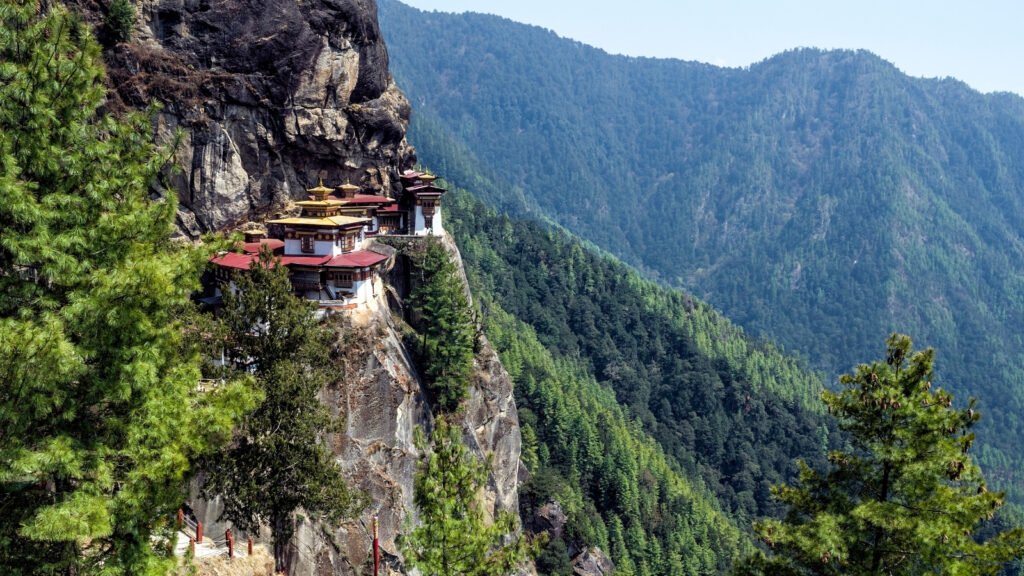
There is a moment on the trail to Paro Taktsang – roughly ninety minutes in, where the path curves around a ridge and the monastery appears for the first time in full – when most people stop walking. Not to rest. To absorb the fact that what they are seeing is real.
Built in 1692 on the sacred cave where the Indian master Guru Rinpoche meditated for three years, three months, three weeks, three days, and three hours in the 8th century, the Tiger’s Nest clings to a sheer granite cliff 900 metres above the valley floor. It does not look like something that should be there. Which is, of course, precisely the point. According to legend, Guru Rinpoche flew to this cliff on the back of a tigress and meditated in its caves — the monastery built centuries later marks the site of that practice and that arrival.
The hike takes four to five hours return, beginning in a forest of blue pine and rhododendron and climbing steadily through prayer flags, mountain air, and a silence that becomes more pronounced the higher you go. At the top, four temples built into the rock face house ancient frescos, butter lamps burning since before most nations currently on earth existed, and monks who live here not as performers but as practitioners.
“You climb expecting a view. You arrive somewhere that asks a question of you instead.”
Best time to visit: March to May for clear skies and rhododendron bloom. September to November for post-monsoon visibility. Go early – before 8am if possible. The cliff catches morning light in a way that afternoons do not replicate.
02 Thimphu —The Capital
Capital City · 2,334m Elevation
That Refused the Ordinary
No traffic lights The world’s only capital guided by traffic officers
Pop. ~170,000 Bhutan’s largest city
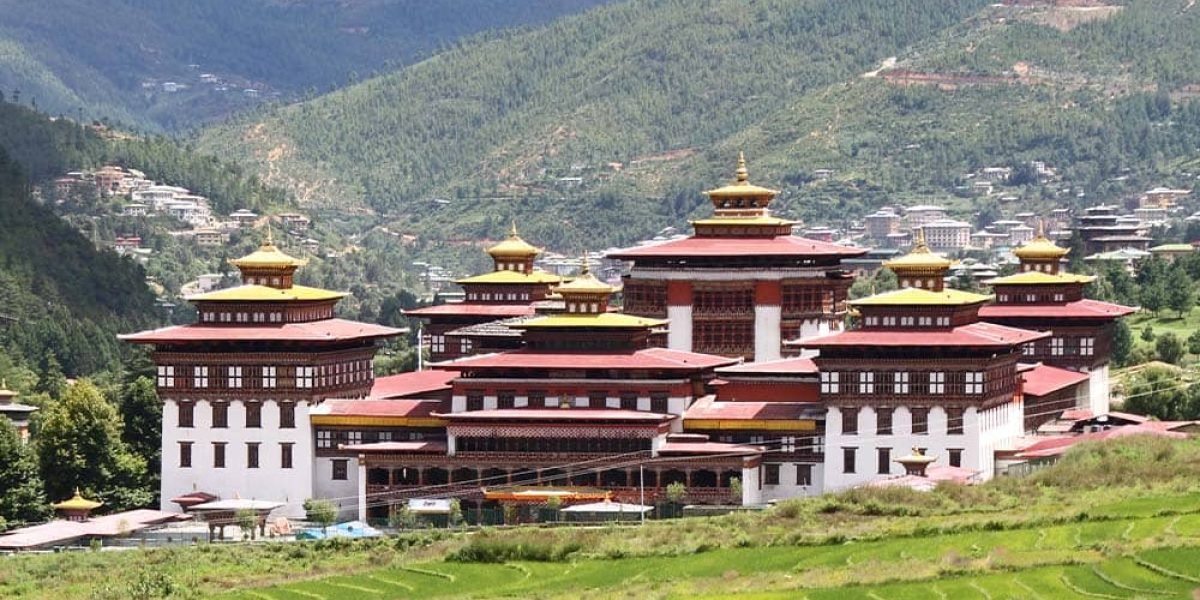
Thimphu is the only capital city in the world without a single traffic light. That fact alone tells you something important about where you are.
This is not a city that submitted to the logic of other cities. Its streets are guided by white-gloved traffic officers at intersections that, in any other capital, would have been automated decades ago. Traditional Bhutanese architectural codes apply to every building — no glass-and-steel tower breaks the skyline. The 169-metre Buddha Dordenma statue gazes over the valley from a forested ridge. Weekend markets fill with farmers who drove in from valleys you may never reach.
Thimphu is where Bhutan’s GNH philosophy is most visibly in operation — in the National Institute for Traditional Medicine, the Centre for Bhutan and GNH Studies, the weekend Centenary Farmers Market, and in the simple fact that the city, despite its role as the political and commercial capital, feels nothing like a capital is supposed to feel. It feels, against all urban logic, manageable. Human. Unhurried.
Do not miss: The Tashichho Dzong at dusk when the evening prayer session begins. The National Textile Museum for the most concentrated introduction to Bhutanese culture available in one building. And the farmers market on a Saturday morning, where the entire food culture of a nation assembles in one covered space.
03 Punakha District · 1,200m
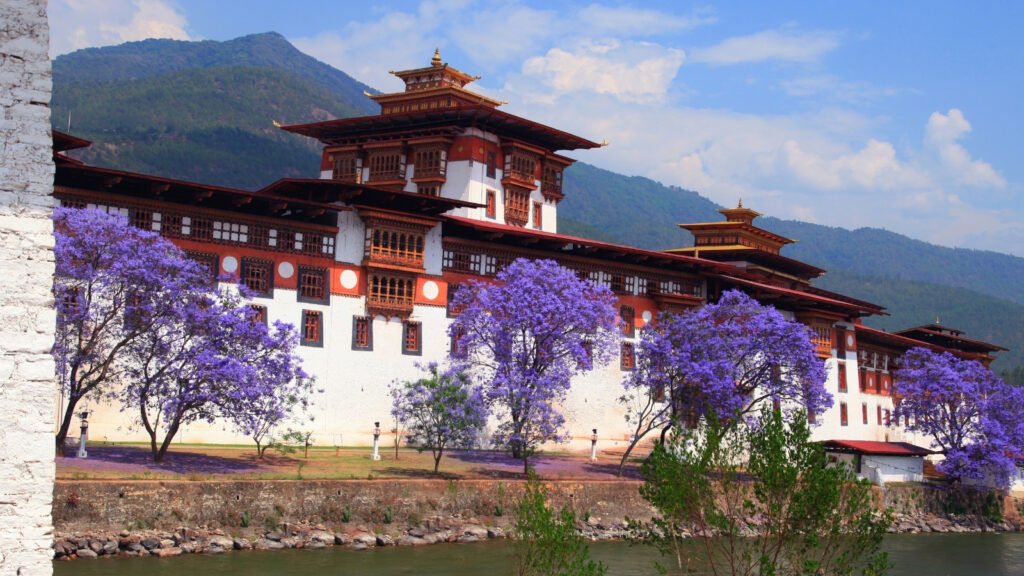
Punakha Dzong — The Palace of Great Happiness
Built 1637 By Zhabdrung Ngawang Namgyal
1,200m Elevation — Bhutan’s warmest major valley
6 storeys Central tower, 183m long
Former capital Until 1955
If you could build a monument at the exact confluence of two rivers and name it “The Palace of Great Happiness,” and then have it survive four centuries of floods, fires, and earthquakes largely intact, and still serve as the winter residence of Bhutan’s chief abbot — you would have Punakha Dzong.
Built in 1637 by Zhabdrung Ngawang Namgyal, Punakha Dzong stands at the confluence of the Pho Chhu and Mo Chhu — the Father River and the Mother River — at 1,200 metres above sea level. Its six-storey central tower, 183 metres long, rises from a promontory of land that the rivers essentially embrace on three sides, creating the impression — especially in winter, when the jacaranda trees along the riverbank bloom in pale purple — of a fortress floating between two bodies of water.
Every king of Bhutan since 1907 has been crowned here. The royal wedding of the Fifth King in 2011 was held within its walls. The dzong is simultaneously a working monastery, an administrative district headquarters, and one of the most architecturally extraordinary structures in Asia. In February and March, the Punakha Tshechu fills its courtyards with masked dancers and thousands of Bhutanese pilgrims in their finest dress.
“Punakha Dzong is not a ruin admired from a distance. It is a living institution that has held Bhutan’s most sacred moments for nearly four hundred years.”
Best time to visit: February to March for the Punakha Drubchen and Tshechu festival. The valley’s lower altitude makes it warm and accessible even in winter, when Paro and Thimphu are cold.
04 Wangdue Phodrang District · 3,000m
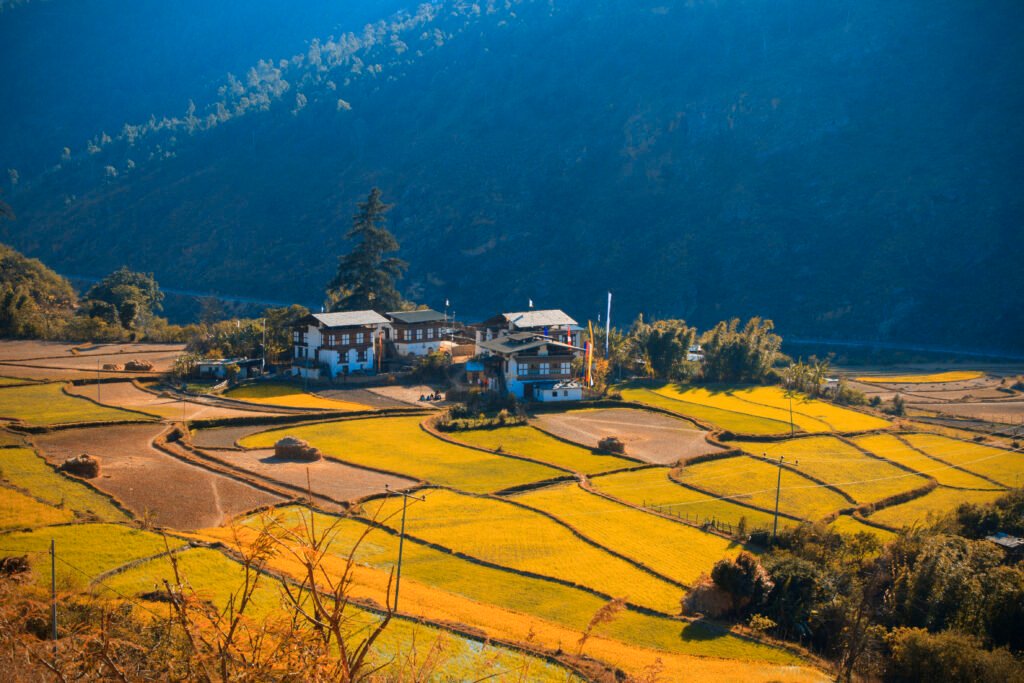
Phobjikha Valley — Where Sacred Birds Circle a Monastery
3,000m Altitude
600+ Black-Necked Cranes winter here annually
163 km² Protected conservation area
11 November Black-Necked Crane Festival annually
Every October, something happens in Phobjikha Valley that the Bhutanese have watched for centuries with undiminished reverence: the Black-Necked Cranes arrive from Tibet.
The cranes circle the Gangteng Monastery three times on arrival — and again, three times, when they depart in spring. Bhutanese folklore holds that this is the birds paying homage to the three sacred jewels of Buddhism. Whether or not you share that belief, the sight of over 600 of these enormous, elegant birds — standing more than a metre tall, with their white bodies and ink-black necks — rising from a glacial wetland at dawn against a backdrop of the Black Mountains, is one of the most quietly extraordinary wildlife encounters available to any traveler anywhere on earth.
Phobjikha is a broad, open glacial valley at 3,000 metres, surrounded by conifer forest and bordered by the Black Mountains National Park. It houses the largest concentration of Black-Necked Cranes in Bhutan during winter, with temperatures dropping to -4°C. Despite the cold, this is the valley where Bhutan’s relationship with the natural world is most visibly, most movingly on display.
Best time to visit: Late October to mid-February for the cranes. The Black-Necked Crane Festival on 11 November at Gangtey Monastery combines traditional mask dances, folk performances, and conservation education in one of the country’s most intimate and authentic cultural celebrations
05 Central Bhutan · 2,600–4,500m
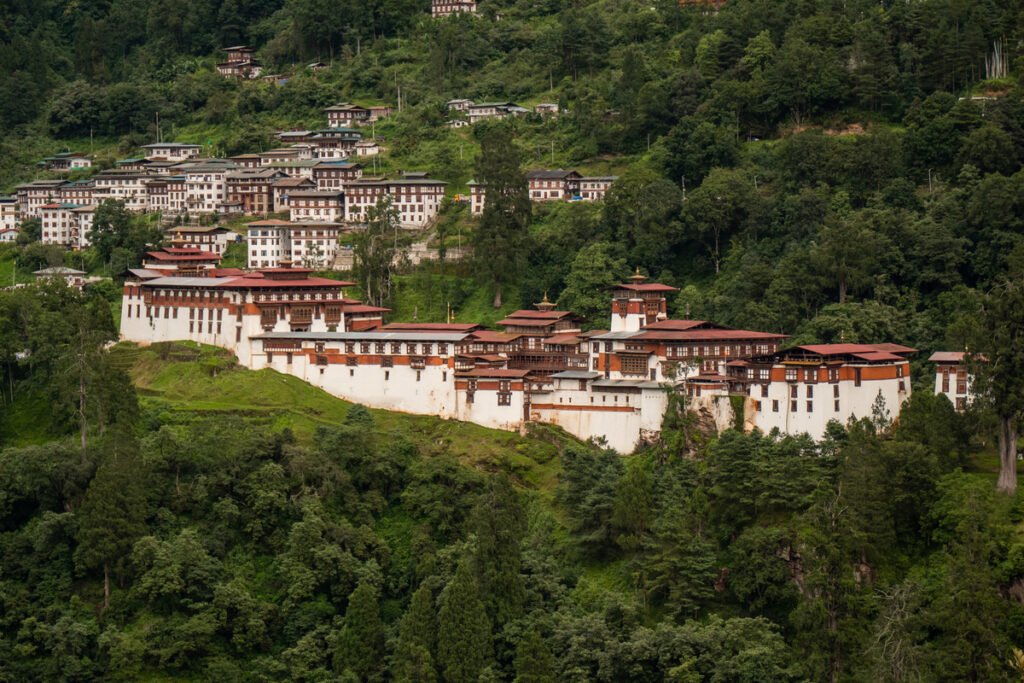
Bumthang Valley — The Spiritual Heartland
4 valleys Choekhor, Tang, Ura, Chumey
2,600–4,500m Elevation range
746 AD First blessed by Guru Rinpoche
Oldest temples In Bhutan
If Paro Taktsang is the image of Bhutan the world recognises, Bumthang is the Bhutan that Bhutanese people hold most sacred.
Four valleys — Choekhor, Tang, Chumey, and Ura — spread across central Bhutan between 2,600 and 4,500 metres, each shaped by ancient glaciers into wide, breathable landscapes of buckwheat fields, apple orchards, and pine forests. This is the first place in Bhutan to have been blessed by Guru Rinpoche in 746 AD, and the evidence of that history is everywhere — in the 7th-century Jambay Lhakhang, one of the oldest temples in the country; in Kurje Lhakhang, built over the cave where Guru Rinpoche left the imprint of his body in solid rock; in the Tang Valley’s Mebartsho — the Burning Lake — where the saint Pema Lingpa dove into the water in the 15th century and emerged carrying sacred texts and a burning lamp, both dry.
Bumthang does not perform its spirituality for visitors. It simply lives it — in the monks walking temple circuits before dawn, in the farmhouses where yak butter is still churned the old way, in the Red Panda Brewery beside the Chamkhar Chu river, where Bhutan’s only domestic beer is made with glacial water and drunk with the unhurried contentment that this valley seems to produce in everyone who spends time in it.
“You need at least three days in Bumthang. Not because there is so much to see — but because the valley takes time to reach you, and it is worth letting it.”
Best time to visit: September to November for the Jambay Lhakhang Drup festival — one of Bhutan’s most sacred and least-touristy celebrations, held by firelight in October. The valley is also spectacular in spring, when the fruit orchards are in full blossom.
◆ ◆ ◆
Five places. Five entirely different encounters with a country that has, for fifty years, made a structured commitment to protecting the things that make it worth visiting. The trail to the Tiger’s Nest. The rivers meeting at Punakha. The cranes circling Gangtey Monastery at dawn. The monks of Bumthang walking paths that Guru Rinpoche walked thirteen centuries before you.
Come with a camera. Come with questions. Come ready, if you can manage it, to put both down occasionally — and simply be somewhere that has never once forgotten why being somewhere matters.